

Walk into any health food store in Canada this fall and you'll find Lion's Mane in capsules, powders, coffee blends, and gummies. Social media is full of claims ranging from "sharpens focus instantly" to "reverses Alzheimer's." Neurologists dismiss it as hype. Supplement brands promise it will transform your brain.
Let’s start with understanding what Lion's Mane does at a biological level.
What Is Lion's Mane?
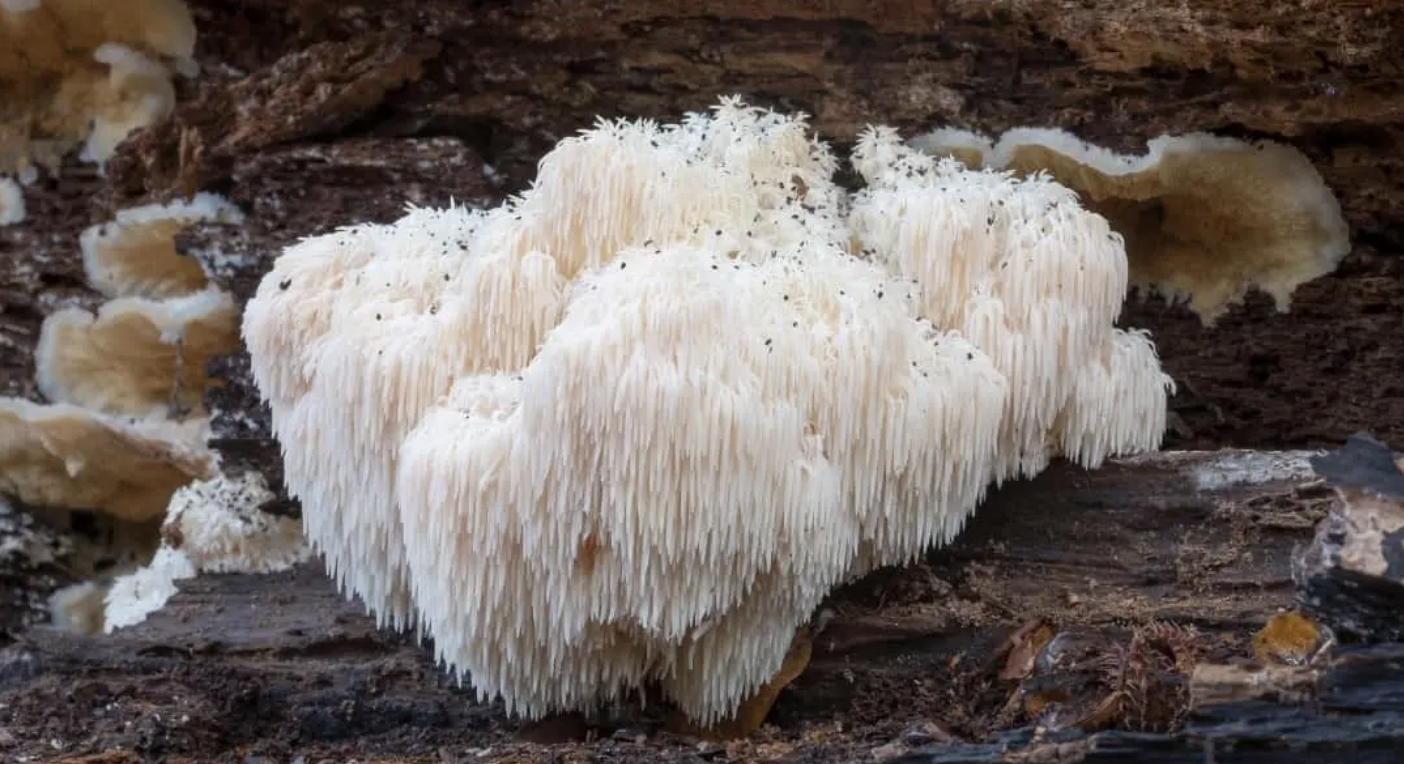
Hericium erinaceus is a large, white, shaggy mushroom found growing on hardwood trees in North America, Europe, and Asia. It has been used for centuries in traditional Chinese and Japanese medicine, valued for what practitioners described as effects on the mind and nervous system.
Modern research has confirmed that Lion's Mane contains two families of bioactive compounds unique to this species: hericenones (found in the fruiting body) and erinacines (found in the mycelium). Both families stimulate the production of Nerve Growth Factor (NGF), a protein your brain requires to grow, maintain, and repair neurons.
NGF doesn't cross the blood-brain barrier on its own. But hericenones and erinacines are small enough to do so, where they trigger neurons to produce NGF themselves. This mechanism has implications for cognitive functions such as memory, learning, and concentration, and makes Lion's Mane one of the few natural compounds with a plausible and documented pathway to neurological benefit.
The Clinical Evidence — What Human Trials Show
Cognitive effects with Lion's Mane supplementation have been mixed based on a few small pilot clinical trials. These trials had small numbers of participants and short durations of treatment, and larger, longer duration trials are needed to evaluate efficacy and safety.
That's the honest state of the evidence. Now here's what the trials actually found.
The Mori et al. 2009 Trial (Phytotherapy Research) This is the most-cited Lion's Mane study, and the one most often misrepresented in supplement marketing. Thirty adults aged 50–80 with mild cognitive impairment (MCI) were randomized to 3g/day of Lion's Mane fruiting body powder or placebo for 16 weeks. The Lion's Mane group showed statistically significant improvement on the Hasegawa Dementia Scale and Mini-Mental State Examination. The catch: scores declined after supplementation stopped, suggesting that Lion's Mane supports ongoing brain function rather than producing permanent changes.
The 2023 and 2024 Acute Studies A recent study comparing Lion's Mane mushroom extract tested cognition, mood, and happiness in healthy participants, significantly improving cognitive performance and self-perceived cognitive indices over a two-hour period. This research challenges the prevailing belief that Lion's Mane can only provide more long-term, chronic benefits, suggesting more immediate cognitive advantages for healthy adults in as little as 60 minutes post-ingestion.
The 2026 Evidence Picture Lion's Mane mushroom has an excellent safety profile based on clinical trials spanning 2009 to 2026. Lion's Mane works best as part of a comprehensive brain health strategy, a finding consistent with the omega-3 research we covered last month, where the USC trial found that brain-penetrating DHA supplements still needed the foundation of diet, sleep, and exercise to produce cognitive benefit.
The Review Literature Shows Only Lion's Mane mushroom appears to offer any benefits to cognition or mood following supplementation among medicinal mushrooms studied, and only in older age groups, following long durations, and at high doses. Short-term studies in young adults have generally been negative or produced only trend-level effects.
The NGF and BDNF Connection
Here's where Lion's Mane gets genuinely interesting for the brain aging conversation.
NGF and its close relative, Brain-Derived Neurotrophic Factor (BDNF), are the brain's primary growth and maintenance proteins. Both decline with age, chronic stress, poor sleep, and sedentary behaviour. Their decline is associated with shrinking hippocampal volume, impaired neuroplasticity, and increased vulnerability to neurodegenerative disease.
As we covered in September's issue, omega-3 fatty acids, specifically DHA, support BDNF production. Exercise is the most powerful known BDNF stimulus. Lion's Mane adds a third lever: direct NGF stimulation through a mechanism that doesn't require crossing the blood-brain barrier in the same way other molecules do.
A 2021 paper by Ratto et al. in Scientific Reports identified two new compounds in Lion's Mane fruiting body — hericene A and B — that were shown to promote NGF synthesis and neurite outgrowth in cell models. These compounds are found in the fruiting body and are structurally distinct from previously studied hericenones. They are not found in mycelium extracts.
This is the key finding that separates the science of Lion's Mane from most of what's being sold in Canadian pharmacies.
The Form Problem: Why What You're Buying May Not Be What Was Studied
Not all mushroom supplements are equal: fruiting body extracts with verified active compound content are what research supports — and this distinction matters significantly for consumer decisions.
Most Lion's Mane supplements sold in Canada fall into one of two categories:
Fruiting Body Extract — the actual mushroom, dried and extracted. This is what the clinical trials used. It contains hericenones, measurable beta-glucans, and the hericene compounds identified in the 2021 Ratto paper.
Mycelium Biomass — the root-like structure of the fungus, grown on a grain substrate (usually oats or rice) and dried. This is what the majority of North American supplement products contain. It may contain some erinacines, but it also contains significant quantities of grain starch — which is not labelled — and substantially lower concentrations of the compounds that produced cognitive benefit in clinical trials.
The distinction matters because when you see "lion's mane" on a label, you have no legal guarantee which form you're getting unless it explicitly states "fruiting body" and lists standardized active compound content.
How to Read a Lion's Mane Label
Before purchasing, look for the following:
- "Fruiting body" explicitly stated — not "full spectrum," not "mushroom complex"
- Beta-glucan content listed and standardized at 25% or higher
- Hericenone content listed where possible
- Third-party testing — NSF Certified for Sport, USP, or Informed Sport
- No "mycelium biomass" or "grain" in the ingredient list
Dosing: The Mori et al. RCT used 3g/day of whole fruiting body powder. Commercial extracts are more concentrated. Most quality extracts are dosed at 500–1,000mg per capsule. Talk to your healthcare provider about dosage and frequency.
Timing: Acute studies suggest cognitive effects may occur within 60 minutes of a single dose. For longer-term cognitive support, consistency over 8–16 weeks appears necessary based on the trial data.
What Lion's Mane Cannot Do
The human evidence is in mild cognitive impairment and early subjective cognitive decline, not advanced neurodegeneration. It is not a treatment for Alzheimer's disease. It does not reverse established dementia.
It works best as part of the broader brain health stack: omega 3s in the right form, quality sleep, regular physical activity, and adequate vitamin D. No single supplement operates in isolation.
An integrated approach to brain health and neurogenesis is what the evidence consistently supports. And Lion's Mane is a meaningful component of that approach, not a shortcut to it.
The Bottom Line
Lion's Mane is the most evidence-supported medicinal mushroom for cognitive function. Its NGF-stimulating mechanism is real, documented, and biologically plausible. The clinical trial data shows genuine benefit in older adults with mild cognitive impairment with the important caveats that the effect requires ongoing supplementation. The benefits are strongest in those already showing early cognitive changes, and the fruiting body extract is what the research used.
If you're shopping for a mushroom supplement for brain health, lion's mane should be the first ingredient on the label, but which form of lion's mane matters as much as the species itself.
References: Mori et al., Phytotherapy Research, 2009 [DOI: 10.1002/ptr.2634]; Ratto et al., Scientific Reports, 2021 [DOI: 10.1038/s41598-021-81861-w]; Applied Food Sciences MycoThrive acute cognition study, 2026; Wali et al., Biomed Res Int., 2026; ScienceDirect review — mushrooms, mood and neurocognitive health across the lifespan, 2024


